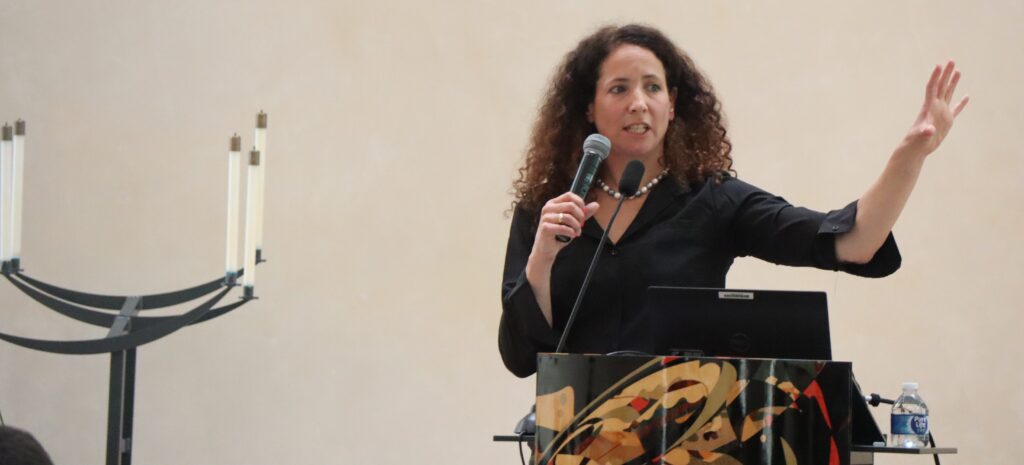
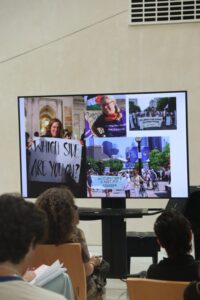
As part of the Engaging the World: Leading the Conversation on the Environment and Building Resilient Futures series and the International Day of Peace, Wilkinson College of Arts, Humanities, and Social Sciences, Schmid College of Science and Technology, Delp-Wilkinson Peace Lecture Series, and the Department of Peace and Justice Studies recently hosted Dr. Atalia Omer (Religion, Conflict, and Peace Studies, University of Notre Dame). Dr. Omer’s work dives into some of the most pressing and complex issues of our time—such as religion, violence, peacebuilding, and the politics of Palestine and Israel. She also brings a deep background in Jewish studies and explores how religion and politics intersect, all through a decolonial lens.
Her talk, We Can’t be Safe and Free Until Palestinians Are Safe and Free: American Jewish Solidarity with Palestinians focused on her book Days of Awe: Reimagining Jewishness in Solidarity with Palestinians (University of Chicago Press, 2019) and how Palestinian suffering has pushed many progressive American Jews to embrace non-Zionist or anti-Zionist activism — and to rethink what their Jewish identity means in today’s political landscape.
Through ethnographic research with both Israeli peace camps and Jewish American activists, Dr. Atalia explained that there has been a shift with a new generation of Jewish activists and discovered that there is a growing number of American Jews who are expressing solidarity with Palestinians, questioning old allegiances to Israel, and transforming the meaning of contemporary Jewishness.
“This is actually a very recent development. This wasn’t the case in the 1920s, necessarily, and so it’s important to have that kind of historical analysis. The research of this book really helped me understand why, almost instantly, there was a change in the Jewish population, including the emergence of new groups,” said Dr. Atalia.

Dr. Omer’s research examines the work of Jewish American social movement organizers, whose actions are grounded in the premise that “my safety is tied to your safety (or, inversely, that my safety and wellbeing cannot be predicated on enacting conditions of insecurity and harm for you).”
“I believe that recognizing what Dr. King called our ‘inescapable network of mutuality’ is vital for the hard work of transforming cycles of violence and ‘acting for peace’ – the theme of this year’s International Day of Peace,” said Dr. Angela Lederach (Peace and Justice Studies). “As Dr. Omer outlined from the interviews and participant-observation she conducted with Jewish American activists engaged in advocating for Palestinian rights, this is not easy, it can be very painful, and there are processes of unlearning, listening, and self-transformation that are part of the work for peace.”
In her talk, Dr. Omer shared how the activists she studies stay committed to the tough, ongoing, and often emotionally challenging work of standing with Palestinians — not in spite of their faith and personal values, but because of them. Their religious beliefs, strong sense of identity, and deeply rooted traditions are what fuel their solidarity.
“I thought she offered a really beautiful reflection on the rich, plural, and dynamic ways that grounding deeply in one’s sense of identity and religious practice can provide the foundation for acting for peace,” said Dr. Lederach. “In other words, recognizing that my safety is bound up with your safety, can still emerge through embracing differences. I think that is really important as we reflect on the practices needed to build more resilient futures for all people and for our planet,” she said.
Dr. Lisa Leitz (Peace and Justice Studies) said, “Dr. Omer challenges the zero-sum thinking of many related to war and justice issues. There is a tendency to believe that one must take sides, especially related to Israel and Palestine. However, for sustainable peace, we must value and promote the security and rights of all.“
(Pictured in header: Dr. Atalia Omer (Religion, Conflict, and Peace Studies, University of Notre Dame). Photo by Violet Gude (’29 Broadcast Journalism).