Faculty Books: Ariosto e la teoria A Book by Dr. Confalonieri
January 22, 2026
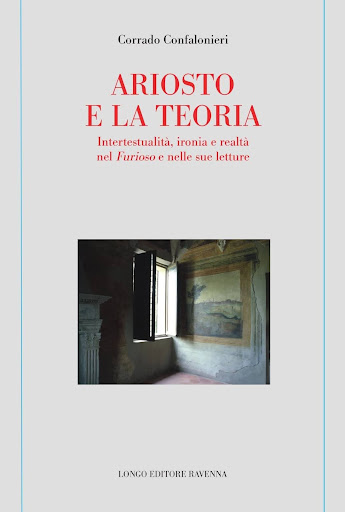 Dr. Corrado Confalonieri (Italian Studies) is a scholar of Renaissance Italian literature and literary theory. His latest book, Ariosto e la teoria. Intertestualità, ironia e realtà nel “Furioso” e nelle sue letture (Longo Editore) brings Ludovico Ariosto’s Orlando Furioso into dialogue with literary theory, focusing on intertextuality, irony, and reality, and tracing how the poem has been read and reinterpreted across centuries and cultural contexts.
The Voice of Wilkinson sat down with Dr. Confalonieri to talk about Ariosto E La Teoria.
The Voice of Wilkinson: Tell the readers a little about the book.
Corrado Confalonieri: I tried to capture the focus of my book directly in its title: Ariosto e la teoria. Intertestualità, ironia e realtà nel “Furioso” e nelle sue letture. The central idea is to bring together the study of one of the great poets of Italian literature – Ludovico Ariosto, author of the Orlando furioso – with literary theory. In particular, I concentrate on three key theoretical issues that have been, and continue to be, fundamental in the history of the poem’s reception: intertextuality, irony, and reality.
VoW: What central ideas or themes does it explore?
Like many Renaissance epics, the Furioso is filled with citations from earlier classical and vernacular literature; it is also an epic poem that plays with humor and irony, engaging with multiple literary genres; and although it is densely intertextual, it is equally rich in references to the real world. For this reason, the subtitle highlights intertextuality, irony, and reality.
The final phrase – “in the Furioso and in its readings” – is important because the book also examines these theoretical problems historically. I look at the diverse ways in which Ariosto’s poem has been read over time. The Furioso is an elusive text, impossible to interpret in a single definitive way, and its interpretations have changed significantly across centuries (from the sixteenth century to today) and across space (for instance, between Italy, the rest of Europe, and the United States).
VoW: What inspired you to write this book?
CC: As I write in the Acknowledgements, this book developed slowly – its origins go back as early as 2012, just a few months before I came to the United States for the first time (at Columbia University, during the fall semester of 2012). Over these years, I worked on various projects, especially on the two books I published in 2022. The research for one of those books – the one on Torquato Tasso’s Gerusalemme liberata – led me to study more and more closely the ways in which Ludovico Ariosto’s Orlando furioso had been read. The Furioso was already considered the most important Italian poem of the sixteenth century when Tasso began to conceive the Gerusalemme liberata.
This phase of the Italian Renaissance – from the early reception of the Orlando furioso (published in 1516, 1521, and 1532) to the composition of the Gerusalemme liberata (published in 1581) – is the period I have studied most throughout my career. It is also a period that has inspired some major American scholarship in Italian literature. My decision to come to the United States for the first time in 2012 was connected to this scholarship and these scholars, just as my later choice to pursue a second Ph.D. in the U.S. – at Harvard University, after completing my first Ph.D. at the University of Padua in 2014 – was shaped by this same intellectual dialogue.
I can say that this book, like the two I published in 2022, was born from studying one of the most important periods in Italian history, the Renaissance, and two of its most celebrated poems – the Orlando furioso and the Gerusalemme liberata – but it also emerged from a dialogue between different scholarly traditions, American and Italian, and from my own journey between Italy and the United States (first the East Coast, now California). The first chapter, in particular, reflects on this journey – a journey both of research and between two countries that have influenced how I believe Italian literature should be studied.
VoW: Is the book currently available in English, or are there plans for an English translation?
CC: The book was published in Italian, but by a press (Longo Editore, in Ravenna) with a long tradition of publishing monographs in Italian Studies by scholars based abroad, especially in the United States. In my field, anyone who studies Italian literature should be able to read Italian, even if they are not a native speaker. By the same token, it has long been expected that scholars who are native speakers of Italian and work on Italian literature should be able to read at least English, and ideally another modern language such as French, Spanish, or German (and, if they study the Middle Ages or the Renaissance, Latin as well).
For this reason, a translation is not strictly necessary for the book to reach its intended scholarly audience . That said, an English translation could certainly be helpful for students. At the moment, I do not have a translation planned, but who knows – perhaps in the future.
VoW: Which number book is this in your body of scholarship?
CC: Ariosto e la teoria is my fourth monograph. Previously, I published a book in 2012 on Eugenio Montale (1896–1981), one of the very few Italian poets to receive the Nobel Prize in Literature (in 1975). After that, I wrote two books – both published in 2022 – that, like Ariosto e la teoria, engage with Renaissance Italian literature and literary theory.
VoW: What do you hope readers will gain or learn from reading it?
CC: The main goal is to bring together the study of Ariosto and one of the most important poems of the Italian Renaissance, the Orlando furioso, with literary theory. In Italy, Italian literature and literary theory are separate academic fields, and it is rather uncommon to combine them. (Without oversimplifying too much: scholars who work on Renaissance literature often engage only minimally with literary theory, while those who work in Comparative Literature or Literary Theory tend to focus mainly on modern literature, not on sixteenth-century texts like the Orlando furioso or the works I study).
Encouraging this dialogue between disciplines that are related yet distinct is one of the aims of my book. Another important goal is to foster and renew the exchange between different scholarly traditions that have been central to the study of the Orlando furioso – and that have been central to my own intellectual path, since I have lived, studied, and worked both in Italy and in the United States. In particular, I hope the book helps reinforce the dialogue between the American and Italian academic traditions.
VoW: Tell me about the photograph on the cover.
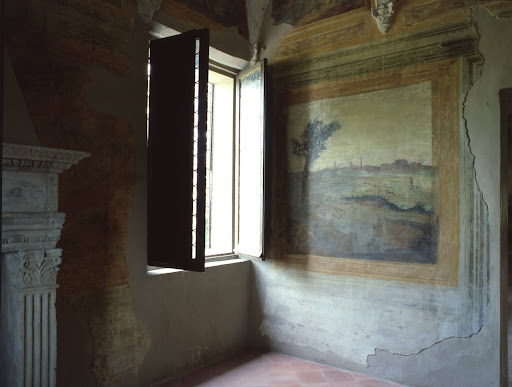
CC: I am especially pleased that I was able to use a photograph by Luigi Ghirri (1943-1992) for the cover (see story photo header). Ghirri was a major Italian photographer who, in the 1980s, took a series of photographs inside the house that once belonged to Ludovico Ariosto’s family. The second-to-last chapter of the book is devoted to this house, which still exists, and to the poem in which Ariosto refers to it as the “Mauriziano.” The final chapter includes additional photographs by Ghirri and attempts to read certain passages of the Orlando furioso through the lens of these modern images, taken in places very close to those Ariosto described, l centuries earlier.
I also feel a personal connection to these photographs because Ghirri came from the same region I am from: he was born in Scandiano, the town where my wife was born, and he lived in Reggio Emilia, the city where we stay when we are in Italy. His images have always changed the way I look at the landscape where I was born and raised – as if, thanks to his photographs, I finally understood what it meant for me to come from Emilia.
After our conversation, Dr. Confalonieri shared that Ariosto e la teoria will be presented at two upcoming academic events. On March 2 he will discuss the book at Harvard University as part of the Lauro De Bosis Colloquium in Italian Studies, and on March 23 he will present at the Institute of Renaissance Studies in Ferrara, Italy, the city where Ludovico Ariosto lived and worked in the sixteenth century.