After the Fires: A Grassroots Mission to Test L.A.’s Soil Safety
May 26, 2026
Robin Jones, founder of the Los Angeles-based company Honey Girl Grows, designs and builds edible gardens for local businesses, such as restaurants and resorts. The 2025 Los Angeles Wildfires deeply affected her local clients and those online who had grown their own edible gardens. In January 2026, Jones began receiving questions on social media about the potential risks of consuming food grown in soil affected by wildfires. What started as a question with no answers became a large-scale investigation into soil.
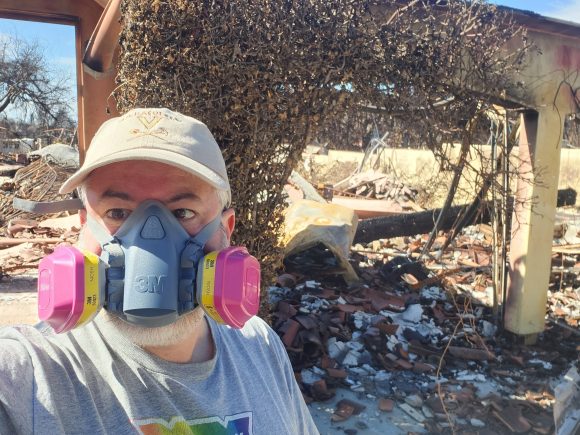
Justin Walsh (Art) sampling soil in the Pacific Palisades, February 2025. Photo Courtesy of Walsh.
After finding little research on the subject, Jones consulted Dr. Justin Walsh (Art), who connected her with soil scientist Dr. Daniel Richter of Duke University, and together they organized a large-scale effort to sample and test soil in the Pacific Palisades and Altadena. The samplings were carried out in two phases from January to February, then again in July and August to track government clean-up efforts. The project involved students, faculty, and homeowners in sampling soil in the affected areas. The entire effort was completely grassroots– no funding or outside support. Just Jones, Richter, and their respective followings. The point, according to Walsh, was “…to give people data for the first time about soil safety in a context where 16,000 structures burned in what was essentially a single megaevent.”
The project’s key findings showed varying levels of lead content across different factors, especially higher concentrations in select older homes. The project also revealed that the Army Corps of Engineers’ efforts were largely successful, as they had scraped for soil within the footprints of burnt structures. However, soil pollution remained very high, including lead and arsenic, in curbsides and yards.
Despite this concern, Walsh is pleased with the project’s outcome. “There were other research groups doing similar work… But as near as I can tell, our little project was the first to validate our results through peer review of our manuscript, and we are the first to report results from testing that happened after cleanup.” Environmental Science and Technology Letters published an article on the effort, crediting Walsh, Richter, Jones, a PhD student of Richter’s, and a high school student from Pacific Palisades who is an intern of Jones’ as co-authors.
Following the study, the team made a YouTube video on Jones’s channel documenting their key findings and is in contact with local media to further publicize their efforts. Although Walsh’s role in the project was comparatively small, having helped connect Jones and Richter and assist in sampling, he is elated by what they have accomplished.
The project carries personal significance for him and Jones. “We know affected homeowners who are still struggling to understand the full scope of their problems… never mind the psychological trauma they have experienced. These people are largely on their own, and it is heartbreaking,” says Walsh about the impact of the wildfires on the LA community. Over 40,000 acres were burned across both areas of the fire, and thousands of residents were evacuated. The rebuilding process is ongoing, and part of it includes monitoring the soil not only for gardens like the ones Jones designs, but also for public health and the future growth of native wildlife.
“I’m very proud that we were able to empower our participants to learn more about their situation, and also that we have generated new benchmark data that will be useful in responding to future urban-wildland interface fires around the world,” Walsh concludes.
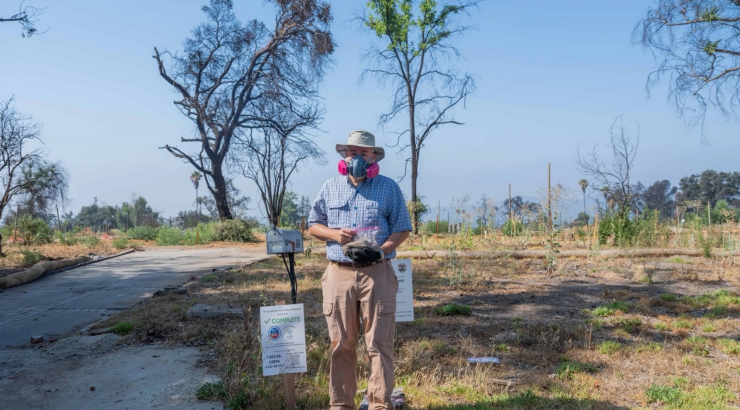
(Photo in header: Justin Walsh (Art) sampling soil in Altadena, August 2025 after their Phase Two cleanup. Photo courtesy of Bridgerain Yu.)